Knowledge Center

Roll Forming Technical Blog & Industry News

Explore expert articles, machinery updates, technical guides, and industry insights from ReformMak.

0%

Choosing the right Granule Vertical Form Fill Seal Machine supplier can affect product consistency, packaging quality, and daily uptime. Granules may flow freely or bridge inside a hopper, and that difference can disrupt feeding. A snack mix, seed blend, or detergent granule may require different dosing settings, film handling, and seal temperatures. Small details matter.

A practical supplier review should look beyond advertised speed. Ask how the machine handles your actual product, bag size, and packaging film. Request a product trial when possible, and check fill-weight consistency, seal appearance, changeover steps, and cleaning access. These checks reveal more than a brochure can. Also review installation support, operator training, spare-parts availability, and response times for service questions. Ask for references from businesses with similar products and production needs.

The best fit depends on your line, not a ranking alone. A compact machine may suit frequent product changes, while a larger system may better support steady, high-volume runs. Compare quoted configurations carefully; included conveyors, printers, and inspection equipment can differ. It is easy to focus on output figures and overlook maintenance access or film waste. I would not assume every supplier tests under the same conditions. Confirm the details in writing, and leave room for questions after the first demonstration. A careful comparison helps identify a machine and supplier that can support reliable production over time.
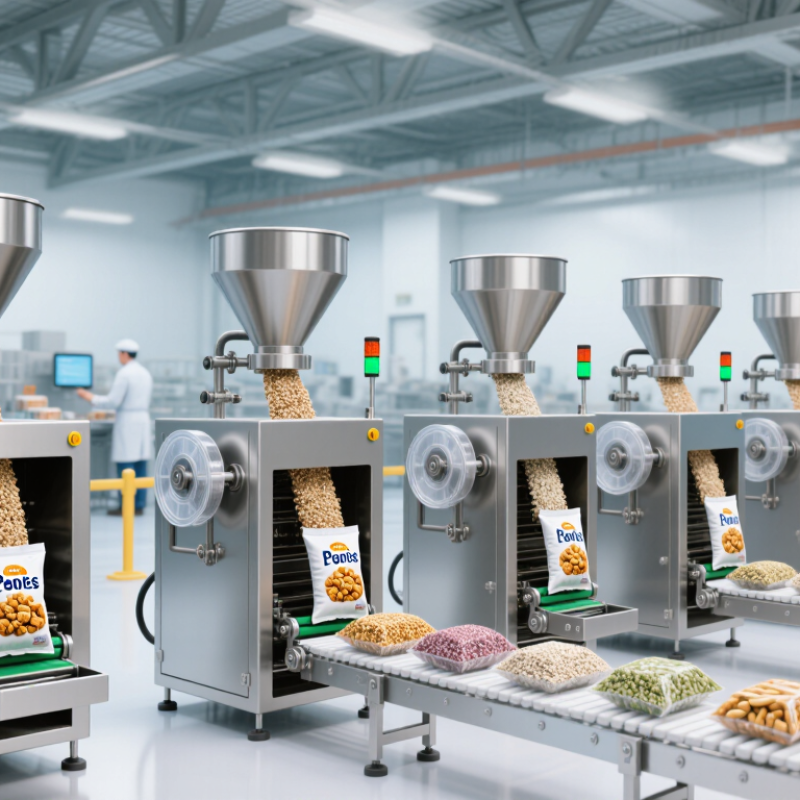
Top Granule Vertical Form Fill Seal Machine Suppliers

Granule VFFS Machines: How Film Forming, Filling, and Sealing Work

A granule VFFS machine turns a flat film roll into a filled pouch in one continuous cycle. The film unwinds under controlled tension, passes over a forming collar, and wraps around a tube. A longitudinal seal closes the tube’s back seam. Then, a weighed dose of granules drops through the tube before cross-sealing jaws form the pouch bottom and top. The jaws also cut the pack free. Small shifts matter. Uneven film tracking can wrinkle the seam, while dust trapped in a seal may cause leaks. Operators typically adjust temperature, pressure, and dwell time to suit the film and product—not just the machine speed.

Filling systems vary: multihead weighers suit free-flowing pieces, while augers or volumetric cups may fit other granule sizes. PMMI’s 2023 State of the Industry report estimated U.S. packaging machinery shipments at about $10.9 billion in 2022, reflecting the scale of equipment investment behind these lines. Smithers’ flexible-packaging market research also places the global sector in the hundreds of billions of dollars, making reliable film handling a practical priority. Still, a fast cycle is not always a good cycle. Check seal integrity, package weight, and film waste during real production runs; sample checks alone can miss drift between batches.

Compare Supplier Output Rates: Typical Lines Run About 30–120 Bags per Minute

Granule vertical form fill seal (VFFS) lines are often rated at roughly 30–120 bags per minute. The range is wide. A compact setup making larger bags may run near the lower end, while a tuned line producing smaller packs can approach the upper end. These figures are useful starting points, not guarantees of everyday output.

Granule size, flow, dust, and bag dimensions all affect speed. Irregular pieces may bridge in a hopper or settle unevenly, causing the weighing system to pause. A 500-gram bag of free-flowing pellets is not comparable to a small pouch of mixed seeds. Ask suppliers to test your actual product and film, then record sustained output over a meaningful run. Peak speed alone can mislead.

Compare quoted rates alongside filling accuracy, changeover time, and rejected bags. Request the bag size, product, and test conditions behind each figure. A supplier should explain whether the rate includes feeding, weighing, sealing, and finished-bag discharge. I would also ask for a short production trial; real factory conditions can expose small delays that a clean demonstration misses. Even then, results may differ once operators change rolls or refill the product hopper.

Check Dosing Performance: Multihead Weigher Targets Often Reach ±0.5–1% Accuracy

For granule vertical form fill seal lines, dosing accuracy starts with how consistently the product flows into each weighing head. A multihead weigher selects a combination of portions to approach the set weight. Targets of ±0.5–1% are often cited, but they are not automatic guarantees. Actual results depend on granule size, bulk density, target weight, machine speed, and vibration. Irregular pellets may settle differently from uniform beads, while dusty pieces can cling to contact surfaces. Small details matter. Calibration and level installation help, but operators should verify performance with real product. Run repeated sample checks on a calibrated scale, then review average weight and variation, not just one favorable pack. That gives useful evidence.

During commissioning, test at the intended speed and with the actual film and pack format. Record start-up, steady-state, and restart results; dosing can shift as product flow changes. A setup log can reveal whether excess giveaway comes from settings, bridging, or inconsistent feeding. Do not assume a supplier’s headline figure will match every recipe or line condition. A clean factory test can flatter results; production is less tidy. That deserves a second look. Useful supplier discussions cover the test method, sample count, acceptable tolerance, and what happens when results drift.

Top Granule Vertical Form Fill Seal Machine Suppliers — Check Dosing Performance

Multihead weigher targets often reach ±0.5–1% accuracy

For a 100 g nominal dose, ±0.5% corresponds to 99.5–100.5 g, while ±1% corresponds to 99–101 g. These are calculated target tolerance bands, not measured machine results; actual performance depends on the product and operating conditions.

Match Machine Specifications to Granule Size, Bag Format, and 50–500 g Fills

A vertical form fill seal machine should be matched to the granules, not just the target weight. Fine powders, rounded seeds, and irregular flakes flow differently and can segregate in the hopper. Ask suppliers to test your actual product, including its smallest particles and largest pieces. Small details matter. Check whether a volumetric cup or combination weigher gives acceptable accuracy across 50–500 g; one setup may not suit that entire range. Record fill variation, product dust, and seal contamination during trials.

Bag format changes the machine specification. Pillow bags generally need different forming parts from gusseted bags, while wider formats affect film width, forming tube, and jaw dimensions. Confirm the required bag length, film type, and seal area before comparing quoted speeds. ISO 7971-2:2019 describes a method for measuring cereal bulk density, a useful reference when evaluating product flow and volumetric dosing. FAO’s 2019 State of Food and Agriculture estimated that 13.8% of food was lost globally between harvest and retail in 2016. Packaging is only one part of that problem, but stable fills and sound seals help protect product quality. Test the real product. Then review the results across several runs; a short trial can miss changes in flow as the hopper empties.

Top Granule Vertical Form Fill Seal Machine Suppliers - Match Machine Specifications to Granule Size, Bag Format, and 50–500 g Fills

Granule Type and Typical Size Product Flow Characteristics Suitable Bag Formats Recommended Dosing System Typical Fill Range Indicative Output Range Key Specification Considerations
Fine sugar or salt, approximately 0.2–1.0 mm Free-flowing; may produce dust during product transfer Pillow bag, gusseted bag Multihead weigher or volumetric cup filler, depending on accuracy needs 50–500 g Approximately 25–60 bags per minute Consider dust extraction, sealed product contact areas, and a film sealing system suited to fine particles.
Rice or small cereal grains, approximately 1–4 mm Free-flowing, with moderate risk of product breakage Pillow bag, gusseted bag, block-bottom bag Multihead weigher or linear weigher 100–500 g Approximately 20–50 bags per minute Use gentle product handling and a forming tube sized for the selected bag width and film type.
Seeds and small pulses, approximately 2–6 mm Generally free-flowing; shape and density vary by product Pillow bag, gusseted bag, stand-up pouch made on a suitable VFFS configuration Multihead weigher or linear weigher 50–500 g Approximately 20–45 bags per minute Check weighing accuracy with the actual product and confirm the bag style is supported by the forming and sealing assembly.
Beans or larger pulses, approximately 5–12 mm Free-flowing but relatively bulky; impact may cause splitting Wide pillow bag, gusseted bag, block-bottom bag Multihead weigher with product-contact parts suited to the product 100–500 g Approximately 15–35 bags per minute Allow sufficient product clearance through the discharge chute and select a bag width that accommodates the fill volume.
Pellets or uniform plastic granules, approximately 2–8 mm Free-flowing and typically consistent in shape and bulk density Pillow bag, gusseted bag Volumetric cup filler or multihead weigher 50–500 g Approximately 25–60 bags per minute Volumetric dosing can suit consistent products; verify dose accuracy if bulk density changes between batches.
Irregular granules or coated products, approximately 3–10 mm Flow and friction can vary; coatings may be sensitive to abrasion Pillow bag, gusseted bag Multihead weigher or product-specific linear weigher 50–500 g Approximately 15–40 bags per minute Test product movement and sealing performance; coating residue or product dust may require cleaning and seal-area controls.

Selection note: Output figures are indicative planning ranges, not guaranteed machine ratings. Actual speed and fill accuracy depend on product size distribution, bulk density, target weight, bag dimensions, film, dosing method, and operating conditions. Confirm performance with product trials and the intended packaging material.

Evaluate Suppliers on Food-Contact Compliance, Service, and Total Cost of Ownership

When comparing top granule vertical form fill seal machine suppliers, verify food-contact compliance at the component level. Request material declarations for product-zone surfaces, seals, and any lubricants that could contact granules. Check traceability. Ask how documents are revised when a gasket, coating, or supplier changes. Requirements vary by product and destination, so have your quality team confirm which standards apply.

Service deserves the same scrutiny as machine specifications. Ask who responds to faults, what support hours are available, and which spare parts are held locally. A useful test is to request a sample maintenance schedule and a clear escalation process. Then consider a practical question: can operators remove and clean the forming tube without awkward tools? It sounds small. It may not be.

Total cost of ownership includes more than the purchase price. Compare expected film waste during changeovers, compressed-air and power needs, cleaning time, routine parts, and training costs. Ask suppliers to state their assumptions; otherwise, estimates may not be comparable. A spreadsheet can still miss a recurring nuisance, such as granules collecting around a poorly placed sensor. I would also ask for a production trial using your own material. Supplier claims matter, but observed changeover time and seal consistency matter more.

FAQS

How does a granule VFFS machine form a pouch?

It unwinds flat film, guides it over a forming collar, and wraps it around a tube. A back seam closes the film, then jaws seal and cut each pouch.

What can cause a pouch seal to leak?

Wrinkled film or granule dust trapped in the seal can create leaks. Operators adjust temperature, pressure, and sealing time to suit the film and product. Small shifts matter.

What production speed should I expect?

Many lines are rated around 30–120 bags per minute. Actual output depends on bag size, granule flow, dust, and filling pauses. Peak speed can mislead.

How can I compare quoted output rates?

Ask what product, bag size, and test conditions were used. Confirm whether the rate includes feeding, weighing, sealing, and bag discharge. Then run your own trial.

How should I match a machine to granule size and fill weight?

Test the actual product, including its smallest particles and largest pieces. Compare filling accuracy across your required 50–500 g range. One setup may not suit every weight.

Which filling system works best for granules?

Multihead weighers often suit free-flowing pieces. Augers or volumetric cups may fit other products, but test fill variation and dust before choosing. It depends.

Do bag formats affect machine specifications?

Yes. Pillow and gusseted bags may need different forming parts. Bag width also affects film width, forming tube, and sealing-jaw dimensions.

What should I inspect during a production trial?

Track package weight, seal integrity, rejected bags, and film waste over several runs. Watch what happens as the hopper empties or operators change film rolls. A short trial can miss drift.

Conclusion

A Granule Vertical Form Fill Seal Machine forms packaging film into a bag, doses granules into it, and seals the package in a continuous production process. When comparing suppliers, consider whether the machine’s output suits your production needs: typical lines run at about 30–120 bags per minute, depending on the product, bag format, and operating conditions. Dosing performance also matters; multihead weighers often target accuracy within ±0.5–1%, though actual results can vary with granule characteristics and setup.

Choose specifications to match the granule size, desired bag style, and fill weights—commonly in the 50–500 g range. Beyond machine speed and accuracy, evaluate food-contact materials and documentation, operator training, spare-parts availability, and after-sales service. Comparing energy use, maintenance needs, and expected downtime alongside the purchase price helps reveal the total cost of ownership and supports a more suitable long-term supplier choice.

Ethan

Ethan

Ethan is a professional marketing specialist with a strong understanding of product strategy, customer needs, and digital communication. As a key member of the company’s marketing team, he combines industry knowledge with practical experience to explain complex product features in a clear,......