Explore expert articles, machinery updates, technical guides, and industry insights from ReformMak.
Choosing among the 7 best Honey Sachet Packaging Machine options requires more than comparing speed and price. A reliable machine must handle honey’s viscosity, temperature, crystallization, and sticky residue. It should also produce clean seals without wasting product. As marketing scholar Philip Kotler explains, “Packaging involves designing and producing the container or wrapper for a product.” That principle remains practical here. The sachet is not merely a wrapper. It protects freshness, supports accurate dosing, and shapes the customer’s first impression.
A strong Honey Sachet Packaging Machine should provide stable filling accuracy, adjustable sachet sizes, and simple cleaning access. Stainless-steel contact parts are important. So are heated filling systems, dependable sealing jaws, and controls that operators can understand quickly. A machine running at impressive speed may still perform poorly with thick honey. That assumption can fail. Small differences matter.
This guide examines seven leading machine types and models through a practical lens. It considers output capacity, sealing quality, material compatibility, maintenance demands, footprint, and total operating cost. It also asks uncomfortable questions. Can the machine maintain accuracy during long production runs? Will syrup build up around the nozzle? Can one trained operator solve ordinary faults without extended downtime? These details often matter more than a polished brochure. No machine is perfect. The right choice depends on product formula, sachet size, packaging film, labor skills, and production targets. Readers should verify specifications, request sample testing, and inspect after-sales support before purchasing. That step may feel slow. It can prevent an expensive mistake.
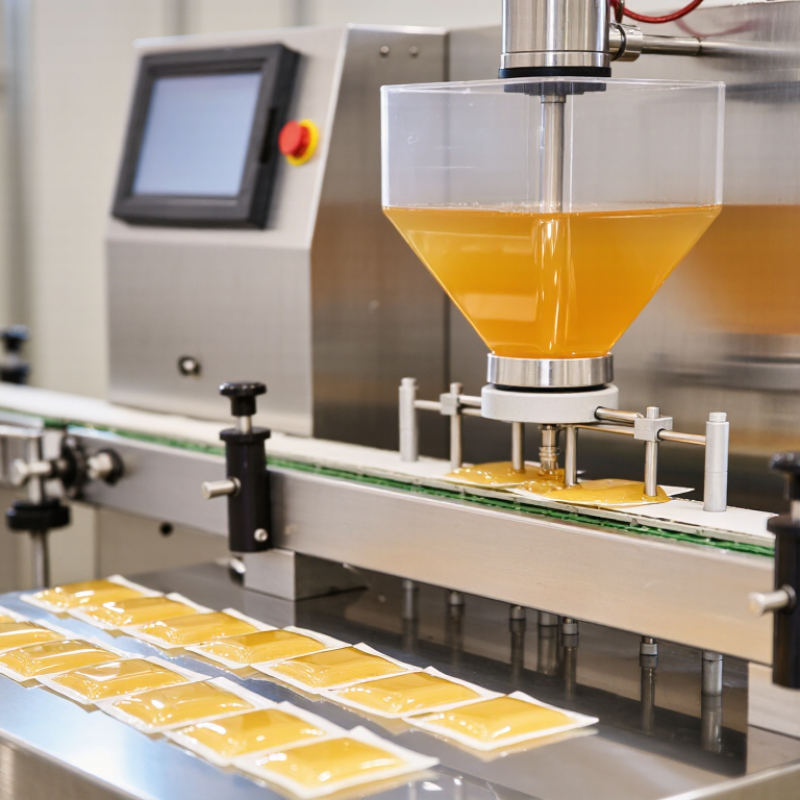
Honey sachet packaging machines turn warm, filtered honey into consistent single-use portions. The process begins in a stainless-steel hopper, where gentle heating keeps the honey flowing without excessive thinning. A piston or servo-driven pump then measures each dose. It pushes the honey through a narrow filling nozzle while a film tube forms around it.
The film unwinds from a roll and passes through tension guides. A forming collar shapes it into a tube. Heat-sealing jaws create the back seam and separate sachets at fixed intervals. Photoelectric sensors read printed marks, keeping each cut aligned. Small errors matter. A slight film shift can leave uneven seals or damaged graphics. Operators should check fill weight, seal pressure, temperature, and cutting timing during every production change.
Reliable machines also include cleanable product paths and accessible inspection points. Honey residue can harden around valves, nozzles, and sealing areas if cleaning is delayed. That creates waste and weakens process control. In practice, no setting works perfectly for every honey type. Floral source, moisture level, crystal formation, and room temperature can change machine behavior. Careful trials help determine the correct pump speed and sealing temperature. Records of these trials support repeatable operation and make troubleshooting more practical. A machine may run quickly, but stable results depend on calibration, film quality, and disciplined operator checks.
How honey sachet packaging machines work: liquid honey is pumped from a heated or temperature-controlled hopper, metered by a dosing system, sealed in a film sachet, and cut into individual packs. The chart compares typical production speeds for seven common machine configurations.
Output figures are typical industry ranges for honey and other viscous liquid sachet applications. Actual performance depends on sachet size, honey viscosity, film material, filling accuracy, and the number of lanes.
What Are the 7 Best Honey Sachet Packaging Machines?
The best honey sachet machine depends on product viscosity, sachet size, and daily production volume. Strong options include single-lane, multi-lane, servo-driven, piston-filling, volumetric, premade-film, and stick-pack machines. Each design solves a different production problem. Honey requires controlled flow, stable temperature, and accurate dosing. A filling system with anti-drip control can prevent sticky sealing areas. That small detail matters.
Key features deserve closer comparison. Check the dosing accuracy at different honey temperatures, not only during ideal trials. Servo motors can improve portion consistency and reduce sudden movements. Multi-lane systems increase output, but they may require more maintenance. Inspect the sealing jaws, film tracking sensors, and emergency controls. Tool-free changeover can save valuable minutes between sachet sizes. Operators should also review cleaning access, compressed-air needs, electrical consumption, and spare-part availability. A machine may appear fast, yet frequent adjustments can reduce real output.
Tips: Request a sample test using your actual honey and packaging film. Measure weight variation, seal strength, leakage, and waste. Ask for production records, training details, and written maintenance schedules. Do not judge speed alone. A quieter machine with simpler controls may perform better every day. The perfect choice rarely exists; practical reliability often matters more than impressive specifications.
The 7 Best Honey Sachet Packaging Machines serve different production needs. FAOSTAT data records roughly 1.8 million tonnes of honey production worldwide in recent years. That volume supports stronger demand for accurate, hygienic filling systems. Flexible packaging also remains significant. Grand View Research valued the global flexible packaging market at over 260 billion dollars in 2022.
The seven strongest options are vertical form-fill-seal machines, stick-pack machines, three-side-seal machines, four-side-seal machines, premade-sachet fillers, multi-lane liquid packers, and servo-driven piston fillers. Vertical systems suit small factories and flexible output. Stick-pack machines reduce material use and create clean, portable portions. Three-side sealing is simple and economical. Four-side sealing gives sachets a sharper appearance. Premade-sachet fillers can improve presentation, but they usually require higher labor costs. Multi-lane machines increase output dramatically. Servo piston fillers offer better control for thick honey.
Look for heated hoppers, anti-drip nozzles, stainless-steel contact parts, and tool-free cleaning. Honey leaves strings and residue. Small design flaws become expensive quickly. PMMI packaging reports repeatedly identify automation, sanitation, and changeover speed as major operational priorities. A practical test should measure fill accuracy, seal strength, leakage, and cleaning time. Do not trust speed claims alone. Real honey behaves differently by temperature, floral source, and moisture content. A machine that performs well in a showroom may struggle during a cold morning shift. That is an important weakness in many buying decisions.
| Machine Type | Typical Pack Format | Best Suited For | Main Advantages | Key Considerations |
|---|---|---|---|---|
| Single-lane vertical sachet machine | One flat sachet at a time, commonly with a three-side or four-side seal | Small to medium production runs and businesses introducing sachet packs | Compact layout, straightforward format changes, and a practical entry point for automated packing | Output is limited by its single filling lane; verify that the dosing system handles viscous honey without dripping |
| Multi-lane vertical sachet machine | Several flat sachets formed and filled in parallel | High-volume production of consistent, single-serve portions | Multiple lanes can increase output while using a coordinated forming, filling, and sealing process | Requires more floor space and careful lane-to-lane dosing and sealing checks; cleaning and changeovers can be more involved |
| Stick-pack machine | Narrow, elongated sachets sealed along the back and across both ends | Portable portions intended for drinks, travel, catering, or on-the-go use | Slender pack format is convenient to carry and open; multi-lane versions are available | Film width and seal design must suit the target portion; the narrow filling tube and product path need to be suitable for honey |
| Flat four-side-seal sachet machine | Flat rectangular sachets with seals on all four edges | Neat, compact portions for food service, samples, and retail multipacks | Creates a flat pack with a clear front and back panel and a sealed perimeter | Seal area and film compatibility are important; the sachet shape may require more material than a narrow stick pack of similar capacity |
| Servo-controlled liquid sachet machine | Flat sachets or stick packs, depending on the forming setup | Applications needing adjustable dosing and repeatable filling control | Servo-driven motion can support controlled indexing and easier adjustment of filling and forming settings | Servo controls do not by themselves guarantee fill accuracy; performance also depends on the pump, product conditions, and machine setup |
| Premade small-pouch filling and sealing machine | Preformed small pouches, including compact portion packs | Operations that prefer to purchase preformed packaging rather than form sachets from a film roll | Avoids on-machine pouch forming and can accommodate pouch designs prepared by a packaging supplier | Confirm that the pouch dimensions, opening, material, and seal layers are compatible with the filling and sealing equipment |
| Semi-automatic tabletop liquid filler with sealing unit | Small batches of sachets or compact pouches, depending on the attached tooling | Product trials, seasonal batches, and low-volume operations | Lower automation requirements and a smaller footprint than a continuous multi-lane production line | Often requires more operator involvement; check whether filling, pouch handling, and sealing are integrated or performed as separate steps |
Choosing the best honey sachet packaging machine depends on viscosity, output, sachet size, and cleaning demands. Honey often crystallizes, so pump design matters.
For small workshops, a single-lane vertical form-fill-seal machine offers affordable control and easy product changes. A piston filler handles thick honey more consistently than a basic gravity filler. Medium producers may prefer a multi-lane sachet machine, which creates several packs simultaneously. Stick-pack machines suit narrow, portable portions.
Intermittent VFFS systems support frequent size changes, while continuous VFFS systems favor steady, high-volume production. Rotary premade-pouch machines fit larger sachets and premium presentation. Servo-driven liquid fillers deliver accurate dosing, especially when portion consistency affects retail trust.
Grand View Research valued the global flexible packaging market at about 148.56 billion US dollars in 2023. Its forecast suggests continued growth through 2030. PMMI’s packaging-industry reports also identify labor shortages and equipment flexibility as major operational concerns. These figures support automation, but they do not make every high-speed machine suitable. A fast line can waste honey when sealing temperature, film tension, or dosing settings are poorly matched.
Tips: Request a live trial using your actual honey. Check cleaning time, drip control, seal strength, and performance after crystallization. Confirm whether operators can change sachet sizes without specialist support. The cheapest machine is not always the wisest choice. I would avoid promising a final speed before testing product temperature and viscosity.
What Are the 7 Best Honey Sachet Packaging Machines?
When comparing seven honey sachet packaging machines, maintenance should receive equal attention to output speed. Honey can crystallize inside narrow filling paths, especially after temperature changes. Operators should inspect the hopper, pump, nozzle, sealing jaws, and product-contact surfaces every shift. Small residue becomes a larger blockage.
Cleaning procedures must match the machine’s construction and approved food-contact requirements. Use documented lockout procedures before opening guarded areas or removing jammed film. Emergency stops, interlocks, and transparent guards need routine testing. They are not decorative features. Keep floors dry, store tools safely, and require suitable gloves and eye protection during cleaning. A missed sensor check can cause empty sachets, leaks, or wasted product.
Operating settings should be adjusted gradually. Excessive filling pressure may create splashes, while weak sealing temperature can produce slow leaks. Check sachet weight, seal strength, film tracking, and date coding at regular intervals. Honey viscosity changes with temperature, so a setting that works in the morning may fail later. Speed is not always efficiency. A slower, stable line often reduces rejected sachets and unplanned stops. Maintenance logs should record parts replaced, alarms, cleaning times, and unusual noise. Some teams rely too heavily on experience alone; that habit deserves reconsideration. Clear training and repeated verification remain more reliable than memory.
Warm, filtered honey enters a stainless-steel hopper. Gentle heat keeps it flowing without making it too thin. A piston or servo pump measures each portion. Film forms a tube around the filling nozzle.
Heat-sealing jaws close the back seam and seal each portion. Cutting blades separate sachets at fixed intervals. Photoelectric sensors read printed marks. Even a small film shift can damage graphics or seals.
Vertical systems suit smaller factories and flexible output. Stick-pack machines create narrow, portable portions. Three-side and four-side sealers offer different appearances and costs. Multi-lane systems produce many sachets quickly.
A heated hopper helps control flow. Servo-driven piston fillers can improve dose accuracy. Anti-drip nozzles reduce strings and waste. Stainless-steel contact parts support easier cleaning.
Floral source, moisture, crystals, and room temperature affect flow. Cold honey may fill slowly. Warm honey may become too fluid. No setting works perfectly for every batch.
Check fill weight, sealing temperature, pressure, and cutting timing. Inspect the sachets for leaks and uneven edges. Test again after changing film or honey temperature. Small errors matter.
Honey residue can harden around valves, nozzles, and sealing areas. Delayed cleaning increases waste and weakens process control. Accessible parts make inspection easier. Cleaning is not optional.
Test real honey, not only water or a showroom sample. Measure fill accuracy, seal strength, leakage, and cleaning time. Run trials on a cold morning if possible. Speed claims can mislead.
A Honey Sachet Packaging Machine is designed to measure, fill, seal, and cut honey into convenient single-use sachets. This article explains the basic working process, from accurate product dosing and film forming to heat sealing and sachet separation. It also outlines the key features buyers should compare, including filling accuracy, production speed, package size flexibility, material compatibility, control systems, ease of cleaning, and overall durability.
The guide reviews seven strong machine types suited to different production requirements, such as compact models for small businesses, flexible systems for varied sachet sizes, and high-output equipment for large-scale operations. It also explains how to match machine capacity and automation level with daily production goals, available space, and budget. Finally, the article highlights essential maintenance, operator safety, sanitation, inspection, and operating practices that help maintain consistent packaging quality, reduce downtime, and extend equipment life.